Seeing the check engine light come on can be stressful. You may immediately wonder: Is my car about to break down? Can I keep driving? How much will it cost to fix?
The good news is that a check engine light doesn't always mean you have a major engine problem. It can be triggered by something as simple as a loose gas cap or by a more serious issue such as an engine misfire, catalytic converter failure, or fuel-system problem.
The important thing is not to ignore the warning.
In this guide, we'll explain the 15 most common causes of a check engine light, what the warning means, when it's safe to drive, and when you should have your vehicle professionally diagnosed.
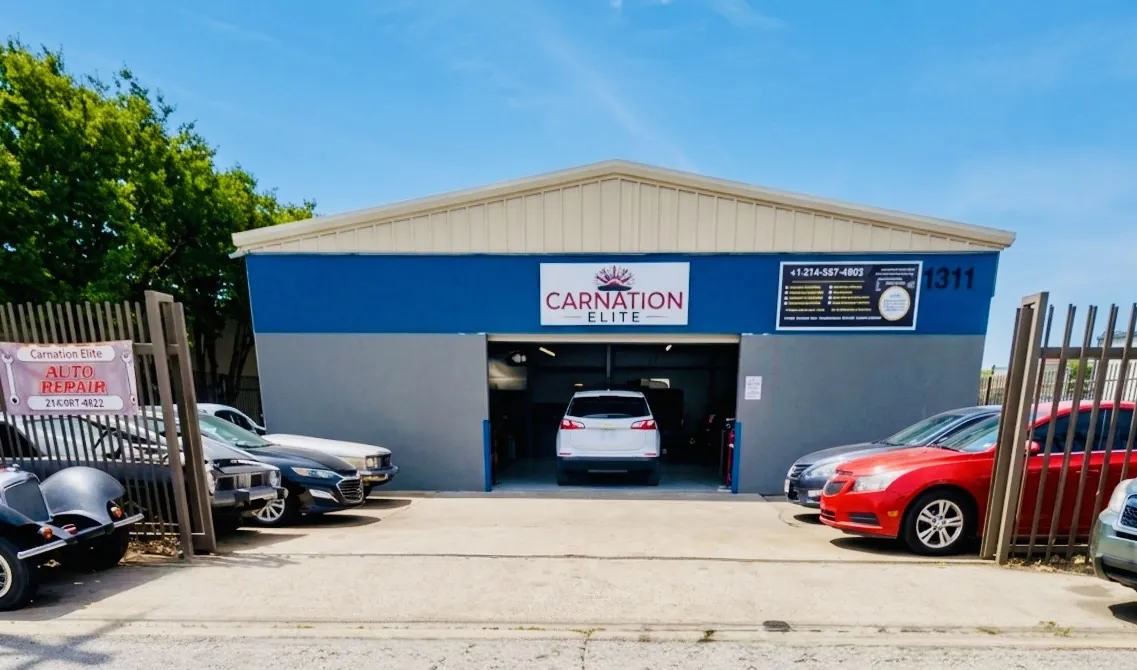
If you're in Dallas, Richardson, Plano, Addison, Garland, or surrounding areas, CarNation Elite can help diagnose check engine light problems and identify the underlying cause before unnecessary parts are replaced.
What Does the Check Engine Light Mean?
The check engine light is part of your vehicle's onboard diagnostics system (OBD-II).
When the vehicle's computer detects that something isn't operating within its expected range, it can store a diagnostic trouble code (DTC) and illuminate the check engine light.
The light may look like:
“Check Engine”
or display an engine-shaped symbol on the dashboard.
However, the light itself doesn't tell you exactly which component has failed.
For example, an oxygen sensor code doesn't necessarily mean the oxygen sensor itself is bad. The sensor may be reporting a problem caused by an exhaust leak, fuel mixture issue, vacuum leak, or another underlying condition.
That's why reading the code is only the beginning of the diagnosis.
15 Common Causes of a Check Engine Light
1. Loose or Damaged Gas Cap
One of the simplest causes of a check engine light is a loose, damaged, or improperly sealed fuel cap.
Your vehicle's fuel system is designed to maintain a specific level of pressure. A leak in the fuel vapor system can trigger an emissions-related warning.
Possible symptoms:
- Check engine light
- Fuel odor
- Difficulty passing an emissions inspection
- No noticeable driving problems
If you recently filled your vehicle with fuel and the check engine light appeared afterward, check that the gas cap is properly tightened.
However, if the light remains on, the vehicle should still be diagnosed.
2. Bad Oxygen Sensor
The oxygen sensor monitors the amount of oxygen in the exhaust and helps the engine computer adjust the air-fuel mixture.
A failing O2 sensor can cause:
- Poor fuel economy
- Rough running
- Increased emissions
- Check engine light
- Reduced engine performance
Modern vehicles can have multiple oxygen sensors, so the diagnostic code can help identify which sensor or circuit requires further testing.
Replacing the sensor without confirming the actual problem isn't always the correct solution.
3. Failing Catalytic Converter
The catalytic converter helps reduce harmful emissions from the engine.
A failing catalytic converter can trigger a check engine light and may cause:
- Reduced engine performance
- Poor fuel economy
- Sulfur or rotten-egg smell
- Excessive heat
- Rattling noises
Catalytic converters can be expensive, so proper diagnosis is especially important.
A catalytic converter may fail because of another underlying problem, such as an engine misfire or excessive fuel entering the exhaust.
Replacing the converter without fixing the original cause can result in another failure.
4. Mass Airflow Sensor Problem
The mass airflow sensor (MAF) measures the amount of air entering the engine.
If the sensor is dirty, contaminated, malfunctioning, or has an electrical problem, the engine computer may receive incorrect information.
Possible symptoms include:
- Rough idle
- Poor acceleration
- Reduced fuel economy
- Stalling
- Check engine light
A MAF-related code doesn't automatically mean the sensor needs replacement. Wiring, air leaks, intake problems, or contamination can also cause inaccurate readings.
5. Worn Spark Plugs
Spark plugs ignite the air-fuel mixture inside gasoline engines.
As spark plugs wear, the engine may experience ignition problems.
Common symptoms include:
- Rough idle
- Hesitation
- Poor acceleration
- Reduced fuel economy
- Engine misfire
- Check engine light
A severe misfire can cause the check engine light to flash.
A flashing light should be treated as an urgent warning.
6. Bad Ignition Coil
Ignition coils generate the electrical energy required to ignite the fuel mixture through the spark plugs.
A failing ignition coil can cause an engine misfire.
You may notice:
- Rough running
- Shaking
- Poor acceleration
- Reduced power
- Difficulty starting
- Flashing or solid check engine light
A diagnostic scan can identify misfire codes such as P0300, P0301, P0302, P0303, and similar codes.
But the code tells the technician where the misfire was detected—not necessarily what component caused it.
7. Vacuum or Intake Leak
An engine needs the correct balance of air and fuel.
A cracked hose, intake gasket leak, or other vacuum leak can allow unmetered air into the engine.
This can cause:
- Lean fuel mixture
- Rough idle
- High or unstable idle
- Poor acceleration
- Check engine light
Common diagnostic trouble codes associated with air/fuel mixture problems include P0171 and P0174.
Proper diagnosis may require checking fuel trims, intake systems, hoses, gaskets, and other components.
8. EVAP System Leak
The EVAP system controls fuel vapors and prevents them from escaping into the atmosphere.
A leak can trigger codes such as:
- P0440
- P0442
- P0455
- P0456
Causes may include:
- Loose gas cap
- Cracked vapor hose
- Faulty purge valve
- Faulty vent valve
- Damaged EVAP component
Some EVAP leaks are extremely small and can be difficult to locate without appropriate diagnostic equipment.
9. Fuel Injector Problem
Fuel injectors deliver fuel into the engine.
A clogged, leaking, electrically faulty, or malfunctioning injector can cause:
- Misfires
- Rough idle
- Poor acceleration
- Reduced fuel economy
- Hard starting
- Check engine light
Fuel-system diagnosis may involve checking injector operation, fuel pressure, fuel trims, and other related systems.
10. Throttle Body Problems
The throttle body controls the amount of air entering the engine.
Modern electronic throttle bodies can experience:
- Carbon buildup
- Electrical faults
- Position sensor problems
- Motor problems
- Wiring issues
Symptoms can include:
- Poor acceleration
- Rough idle
- Reduced power
- Stalling
- Check engine light
Some vehicles may also enter a reduced-power or limp mode when a throttle-related problem is detected.
11. EGR Valve Problem
The exhaust gas recirculation (EGR) system helps control emissions by routing a controlled amount of exhaust gas back into the engine.
An EGR valve that becomes stuck, clogged, or electrically faulty can trigger a check engine light.
Possible symptoms include:
- Rough idle
- Hesitation
- Poor acceleration
- Engine knocking
- Reduced performance
EGR problems are particularly important to diagnose correctly because carbon buildup and electrical faults can produce similar symptoms.
12. Engine Misfire
An engine misfire occurs when one or more cylinders fail to burn the air-fuel mixture correctly.
A misfire can be caused by:
- Spark plugs
- Ignition coils
- Fuel injectors
- Vacuum leaks
- Low compression
- Fuel-pressure problems
- Timing problems
- Mechanical engine issues
A common misfire code is P0300, which indicates random or multiple-cylinder misfires.
Codes such as P0301, P0302, P0303, and P0304 can indicate a misfire detected on a specific cylinder.
Don't ignore a flashing check engine light.
A severe misfire can send unburned fuel into the exhaust system and potentially damage the catalytic converter.
13. Low Fuel Pressure
Your engine needs adequate fuel pressure to operate correctly.
Low fuel pressure can be caused by:
- Weak fuel pump
- Restricted fuel filter
- Fuel-pressure regulator problem
- Wiring issue
- Fuel delivery problem
Symptoms may include:
- Hard starting
- Stalling
- Lack of power
- Hesitation
- Poor acceleration
- Check engine light
Fuel pressure should be tested rather than assuming the fuel pump is automatically the problem.
14. Coolant Temperature Sensor Failure
The engine computer relies on temperature information to control fuel delivery, ignition, cooling fans, and other systems.
A faulty coolant temperature sensor can provide incorrect information to the computer.
Possible symptoms include:
- Poor fuel economy
- Hard starting
- Rough running
- Cooling fan problems
- Check engine light
This is another example of why diagnostic testing is important before replacing a component.
15. Electrical or Wiring Problems
Modern vehicles rely heavily on electrical systems.
A damaged wire, poor ground, corroded connector, blown fuse, or voltage problem can cause multiple warning lights and diagnostic trouble codes.
Electrical problems can sometimes be particularly difficult to diagnose because the failed component isn't always the source of the problem.
A professional technician may need to check:
- Battery voltage
- Charging system
- Grounds
- Power supplies
- Wiring continuity
- Connector condition
- Module communication
Is It Safe to Drive With the Check Engine Light On?
This depends heavily on whether the light is solid or flashing and how the vehicle is behaving.
Solid Check Engine Light
A solid check engine light generally indicates that the vehicle has detected a problem but isn't necessarily experiencing an immediate catastrophic failure.
If the vehicle:
- Runs normally
- Isn't overheating
- Isn't losing power
- Doesn't have unusual noises
- Isn't shaking or misfiring
you may be able to drive it a short distance to a repair shop.
However, you should still have the problem diagnosed.
What Does a Flashing Check Engine Light Mean?
A flashing check engine light is much more serious.
It can indicate a severe engine misfire that may cause damage to the catalytic converter or other components.
If your check engine light is flashing and the vehicle is shaking, losing power, or running poorly:
Reduce driving and have the vehicle inspected as soon as safely possible.
Continuing to drive a vehicle experiencing a severe misfire can turn a relatively manageable repair into a much more expensive one.
Can a Check Engine Light Turn Off by Itself?
Yes.
Sometimes a temporary condition causes a warning light to appear and the light may eventually turn off after the vehicle completes additional drive cycles.
However, that doesn't necessarily mean the underlying issue is permanently fixed.
The vehicle may still have a stored or pending diagnostic trouble code.
If the light repeatedly comes back, don't simply clear the code.
Find out why the vehicle detected the problem.
Does a Check Engine Light Always Mean an Expensive Repair?
No.
Some check engine light problems are relatively inexpensive.
For example:
- Loose gas cap
- Minor EVAP leak
- Sensor issue
- Vacuum leak
Other problems can be much more expensive:
- Catalytic converter failure
- Fuel-system problems
- Major misfires
- Engine mechanical problems
- Transmission-related faults
The only reliable way to estimate the repair cost is to diagnose the vehicle and identify the actual cause.
Why You Shouldn't Just Replace the Part Named by the Code
This is one of the biggest mistakes vehicle owners make.
Suppose your scanner displays an oxygen sensor code.
That doesn't automatically mean:
“Replace the oxygen sensor.”
The code could be related to:
- Exhaust leaks
- Fuel mixture problems
- Vacuum leaks
- Wiring
- Sensor contamination
- Engine performance problems
A diagnostic code is a starting point for troubleshooting, not always a parts-ordering instruction.
Professional diagnosis can help prevent unnecessary parts replacement.
How Much Does Check Engine Light Diagnosis Cost in Dallas?
The cost of diagnosing a check engine light varies depending on the vehicle, problem, and amount of testing required.
A basic diagnostic inspection may involve:
- Scanning the vehicle's computer.
- Retrieving stored codes.
- Checking freeze-frame information.
- Reviewing live data.
- Inspecting related components.
- Performing additional tests.
- Confirming the root cause.
More complicated electrical, drivability, or intermittent problems can require additional diagnostic time.
The cheapest diagnostic scan isn't always the best value.
The goal should be accurate diagnosis, not simply retrieving a code.
Check Engine Light Diagnostic in Dallas, TX
If you're searching for check engine light repair in Dallas, choose a repair shop that can do more than simply read the code.
At CarNation Elite, our diagnostic process focuses on identifying the underlying problem so you can make an informed repair decision.
Depending on the vehicle and symptoms, diagnosis may involve:
- OBD-II scanning
- Diagnostic trouble code analysis
- Live-data analysis
- Electrical testing
- Sensor testing
- Fuel-system diagnosis
- Ignition-system testing
- Visual inspection
- Mechanical testing
Our goal is simple:
Find the problem before replacing unnecessary parts.
What Information Should You Give Your Mechanic?
When you bring your vehicle in, tell the technician everything you've noticed.
For example:
- When did the check engine light appear?
- Was the vehicle recently serviced?
- Did you recently fill the gas tank?
- Is the engine shaking?
- Is the vehicle losing power?
- Is fuel economy worse?
- Is the engine difficult to start?
- Are there unusual smells or noises?
- Is the light solid or flashing?
These details can help the technician narrow down the problem faster.
5 Things You Should Do When Your Check Engine Light Comes On
1. Don't panic.
A check engine light doesn't automatically mean your engine is failing.
2. Check whether the light is solid or flashing.
A flashing light requires more urgent attention.
3. Pay attention to how the vehicle drives.
Look for shaking, loss of power, overheating, strange noises, or unusual smells.
4. Don't randomly replace parts.
Get the problem properly diagnosed.
5. Schedule a diagnostic inspection.
The sooner you identify the problem, the more options you may have.
Frequently Asked Questions
What is the most common reason for a check engine light?
There isn't one single cause for every vehicle. Common causes include EVAP leaks, oxygen sensor issues, ignition problems, misfires, air/fuel mixture problems, and emissions-system faults.
Can I drive with a solid check engine light?
If the vehicle is running normally and the light is solid, it may be possible to drive a short distance to a repair facility. However, the vehicle should still be diagnosed promptly.
Can I drive with a flashing check engine light?
A flashing check engine light can indicate a severe misfire or other serious problem. Avoid unnecessary driving and have the vehicle inspected as soon as safely possible.
How do I find out why my check engine light is on?
An OBD-II diagnostic scan can retrieve the vehicle's trouble codes. However, the code should be followed by proper testing to determine the underlying cause.
Will disconnecting the battery turn off the check engine light?
Disconnecting the battery may clear certain stored information, but it does not repair the underlying problem. The light may return once the vehicle detects the fault again.
How long can I drive with the check engine light on?
There isn't a universal time limit. It depends on the underlying problem. If the vehicle is running poorly, overheating, losing power, or the light is flashing, don't continue driving unnecessarily.
How much does it cost to fix a check engine light?
There is no single price. A minor issue may cost relatively little, while problems involving catalytic converters, fuel systems, engine components, or electrical systems can cost significantly more.
Final Thoughts
A check engine light should never be ignored, but it also doesn't mean your engine is about to fail.
The most important distinction is between reading a diagnostic code and diagnosing the actual problem.
A scanner can tell you what the vehicle's computer detected. A trained technician needs to determine why it happened.
Whether your vehicle has an oxygen sensor code, misfire, EVAP leak, fuel-system problem, throttle-body issue, or another diagnostic trouble code, proper testing can help you avoid unnecessary repairs.
If you're dealing with a check engine light in Dallas, TX, CarNation Elite can help identify the underlying problem and explain your repair options.
Don't guess. Don't replace parts blindly. Get the problem diagnosed.
Need Check Engine Light Diagnosis in Dallas?
Contact CarNation Elite today to schedule a professional vehicle diagnostic inspection.
Get a straight answer on your car
Describe what you're seeing and we'll tell you how urgent it is. Written quote before any work starts.
Book Appointment Call (214) 597-4922